Product concept
Estradiol in Context
Designing clear, useful digital health experiences for users and healthcare professionals.
Role
Research, UX/UI design, concept development, prototyping
Date
2026 — ongoing
- Digital health
- Women's health
- Health data
- UX/UI design
- Data visualisation
- User research
- Patient-centred design
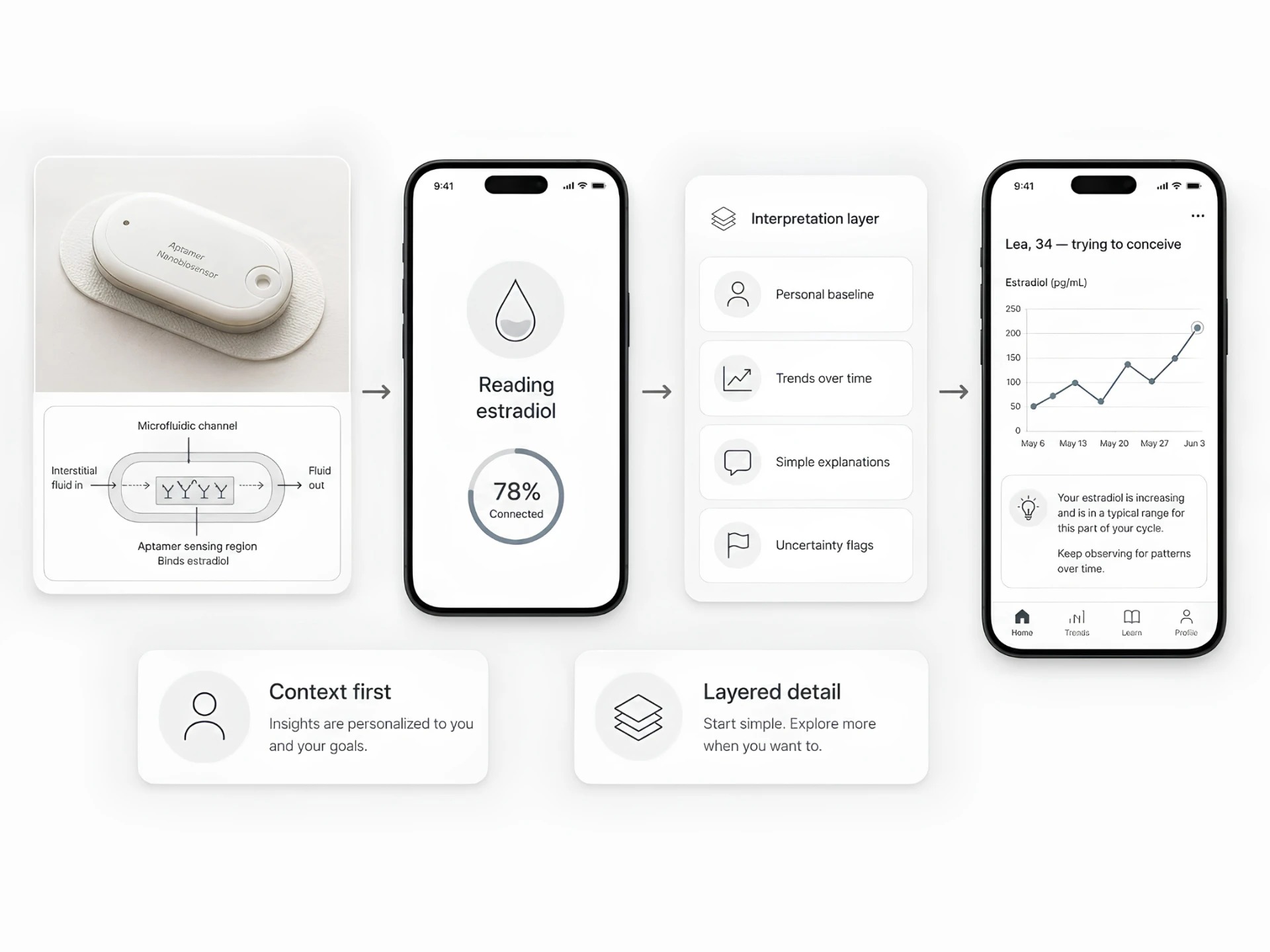
The sensor patch visual is AI-generated and intended as a concept illustration, not a real device.
Focus
- User research and co-design across life stages
- Patient and clinician interface concepts
- Layered data visualisation and clear explanations
01
The opportunity
Hormone information is often based on isolated tests or retrospective symptom tracking. This can make it difficult for people and clinicians to understand changing patterns over time. This project explores a future wearable patch that could measure estradiol continuously through sweat. The focus is not only on collecting data, but on making that data meaningful. How can an app explain hormone patterns without overwhelming people, creating unnecessary anxiety, or suggesting more certainty than the data can provide?
02
The challenge
Continuous health data can be useful, but raw values alone are difficult to interpret. Different people also need different kinds of support. Someone trying to conceive may want to understand changes across their cycle. Someone in perimenopause may be more interested in recognising longer-term patterns and connecting them to everyday experiences. Clinicians need a clearer overview that supports conversation and follow-up. The challenge was to design one system that works with the same data while presenting it in ways that fit different needs, contexts, and levels of health knowledge.
03
My role
- Framing the problem and defining the project scope
- Reviewing research on hormone tracking, self-tracking, and health communication
- Designing the study approach, co-design activities, and interview materials
- Developing patient and clinician user perspectives
- Creating interface concepts, wireframes, and data-feedback variations
04
Research approach
The project uses co-design to understand what people consider helpful, understandable, and appropriate hormone feedback. The research explores two life stages: women who are trying to conceive, and women in the perimenopausal transition. Participants review and discuss different interface concepts. These vary in the type of information shown, the level of detail, visualisation style, and wording. The goal is to learn how women make sense of estradiol data, what feels supportive, and what may feel confusing, overly medical, or pressuring.
05
Design principles
- Start with context — Show trends, personal reference points, and simple explanations instead of presenting isolated numbers without meaning.
- Offer layered detail — Provide a clear overview first, with deeper data and explanations available when a user wants them.
- Adapt to different users — Patient and clinician views use the same underlying data but differ in language, detail, and interaction needs.
- Communicate uncertainty clearly — Avoid presenting data as a diagnosis or instruction. Make variation and limitations visible in an understandable way.
06
The product concept
The concept is a patient- and clinician-facing application connected to a future estradiol-monitoring wearable. For patients, the app presents current patterns, changes over time, and short explanations in clear language. It is designed to support orientation and reflection rather than constant optimisation. For clinicians, the interface offers a more detailed overview of longitudinal trends, personal baselines, and potentially relevant changes. This can support conversations and help place a single appointment or test result in a broader context.
07
From data to understandable feedback
A central part of the concept is an interpretation layer between the wearable sensor and the interface. Instead of showing raw data alone, the system translates measurements into meaningful outputs such as:
- Personal baseline comparisons
- Changes and trends over time
- Simple pattern summaries
- Contextual explanations
- Flags for review in the clinician view
08
The technical concept
The technical concept combines transparent rule-based logic with machine-learning methods for pattern classification and anomaly detection. The purpose is not to replace professional judgement, but to make complex data easier to explore and discuss.
09
Outcome
Estradiol in Context brings together research, design, software, and data thinking in one digital health concept. The outcome is an ongoing research and prototype project that demonstrates how continuous hormone data could be turned into a more understandable experience for both patients and clinicians. It provides a foundation for co-design research, future prototype iterations, and discussion around responsible hormone-monitoring technology.
10
Reflection
This project took a more research-focused approach than my previous work and introduced me to participatory design and co-design methods. Working across multiple user groups reinforced that digital health products need to account for different experiences, needs, and forms of expertise. It also showed me that technically accurate information is not enough: products need to fit people’s lives, respect uncertainty, support autonomy, and give users meaningful control over what they see and when they see it.