Mobile App
NUA
A digital wellbeing app designed to support women during menopause.
Developed as part of a group project
Role
Product research, UX/UI design, mobile-app development
Date
2024 — 3 months
- Digital health
- Menopause
- Mental wellbeing
- Women's health
- UX/UI design
- Product design
- Flutter
- Swift
- iOS
Focus
- Target-group and market research
- UX/UI concepts and a working iOS app
- Privacy, trust, and responsible handling of sensitive content
01
The opportunity
Menopause can affect sleep, mood, confidence, relationships, and everyday routines. Yet many women still lack accessible information, relatable support, and digital spaces that feel trustworthy rather than clinical or overwhelming. NUA was created to explore how a mobile product could support psychological wellbeing during this life stage. The aim was to create an experience that feels calm, clear, and respectful of the personal nature of menopause.
02
The challenge
Health and wellbeing apps can easily create pressure: too much tracking, too much advice, or too much focus on symptoms. For a sensitive topic such as menopause, the product needed to offer useful support without making users feel judged, monitored, or alone. The challenge was to build a mobile experience that balances information, emotional support, privacy, and a clear user journey. Every feature needed to feel purposeful and easy to use in daily life.
03
My role
- Researching the target group, existing products, and market context
- Defining the product focus, user needs, and core features
- Developing the product concept and information structure
- Designing the visual identity and mobile interface
- Creating user flows, wireframes, and high-fidelity screens
- Implementing app functionality for iOS using Flutter and Swift
- Considering privacy, trust, moderation, and the responsible handling of sensitive health-related content
- Testing and refining the experience throughout development
04
Understanding the user context
The product was designed for women navigating menopause and related changes in wellbeing. Research focused on the practical and emotional side of this experience: uncertainty, changing symptoms, a lack of clear information, and the need for support that fits into everyday life. This shaped a product direction centred on three needs: clear, approachable information; space for personal reflection and wellbeing support; and a trustworthy and respectful digital environment.
On support
Support should feel available when needed, without demanding constant attention.
Product direction
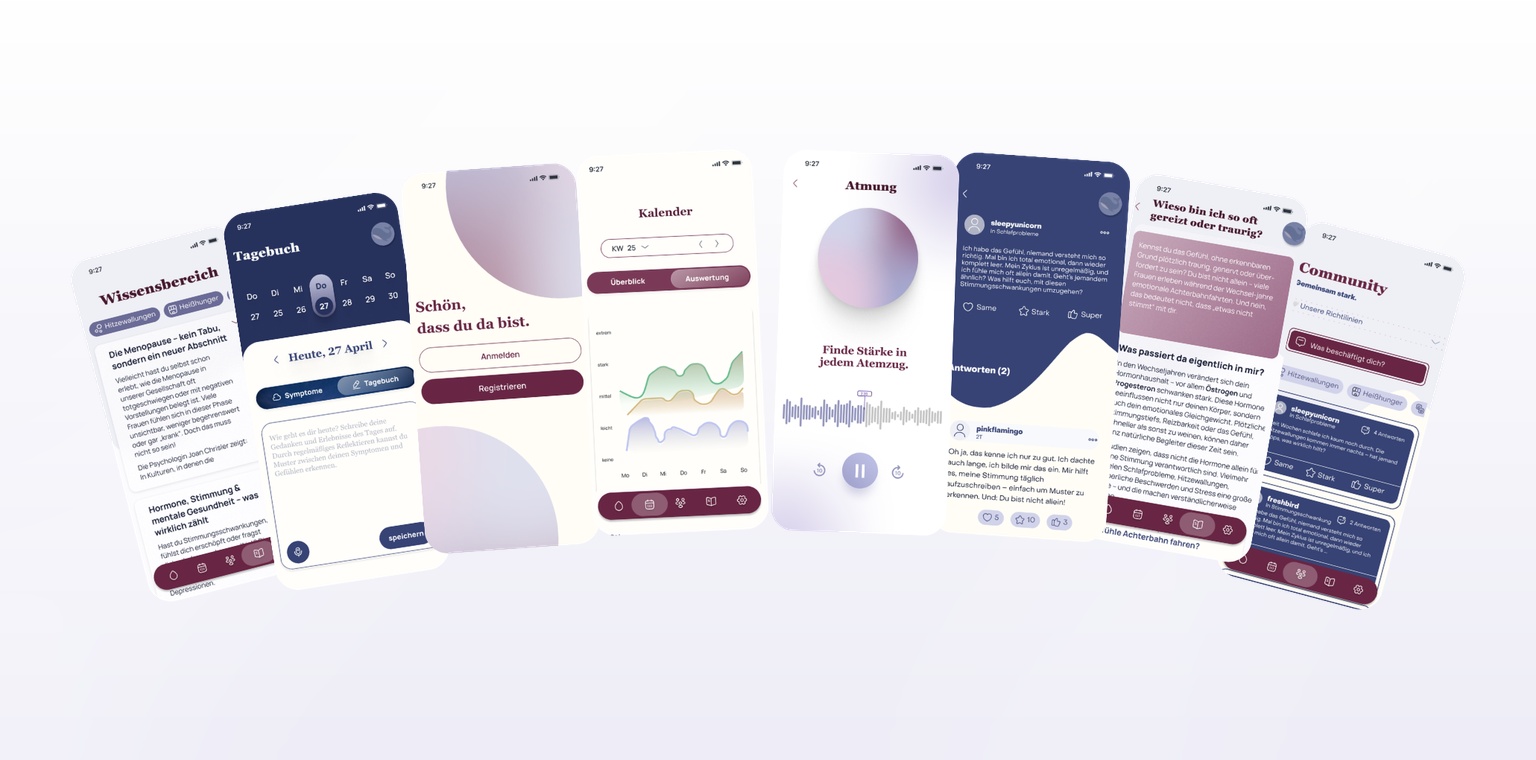
NUA brings together several parts of a supportive digital experience. The app is designed to help users engage with menopause-related wellbeing in a way that feels personal, manageable, and non-judgemental.
Understand
Accessible information and guidance designed to make menopause-related topics easier to navigate.
Reflect
Simple ways to notice and reflect on wellbeing, moods, and everyday experiences over time.
Connect
Features that support a sense of community and reduce isolation, with attention to safety, privacy, and respectful interaction.
05
Designing for trust
Menopause and mental wellbeing are personal topics. NUA was therefore shaped by questions of trust as much as usability. The experience considers clear and non-alarming language, respectful presentation of sensitive topics, privacy around personal information, safe and moderated interactions where community features are involved, and a calm interface that avoids information overload. The design does not assume that one experience of menopause fits everyone. It aims to provide a flexible starting point that users can adapt to their own needs.
06
Outcome
NUA resulted in a working mobile health and wellbeing application that connects research, product thinking, interface design, and software development. The project demonstrates how an early health-product idea can be carried through into a tangible digital experience. It also strengthened my ability to move between understanding a user need, defining a focused product direction, designing the interaction, and building the application.
07
Reflection
NUA built on my earlier experience in digital health and gave me the opportunity to design for a user group with needs and perspectives different from my own. It made me think more carefully about menopause as an often overlooked topic, and about the understandable caution users may have towards health apps and personal health discussions. The project showed me that health-product development is not only about adding useful features, but also about deciding what not to include and creating an experience that feels respectful and trustworthy.