Technical project
Interactive 3D Spine Visualisation
An interactive Python application for exploring CT data, vertebra segmentation, and spinal alignment in 3D.
Role
Visualisation and interaction development
Date
2025 — 3 weeks
- Python
- VTK
- Medical imaging
- 3D visualisation
- CT data
- Interaction design
- Image processing
Focus
- Interactive 3D exploration of CT data and vertebra surfaces
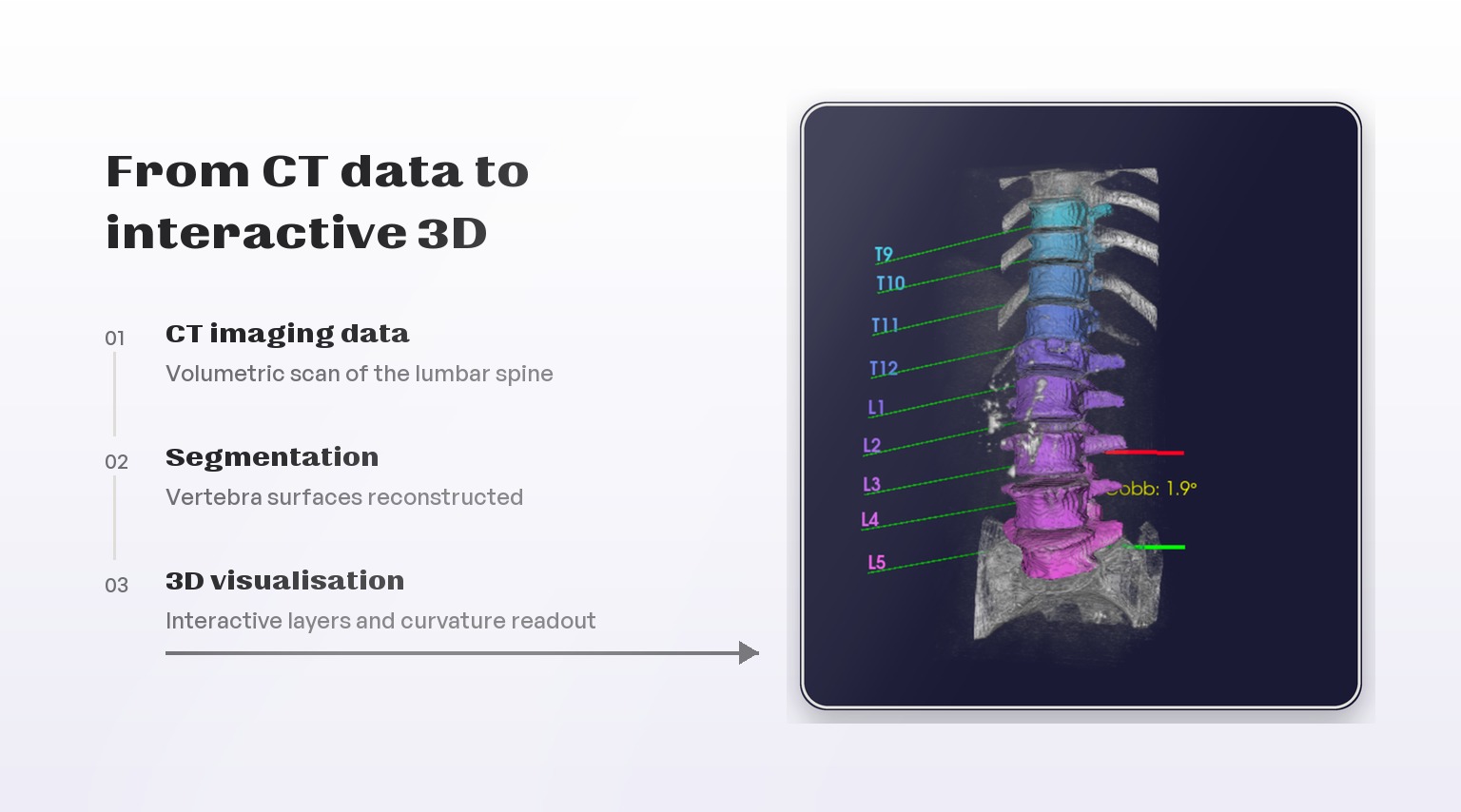
- Spine-centreline, curvature overlays and angle approximation
- Educational visualisation, not a clinical tool
01
The opportunity
Spinal curvature is often assessed through 2D medical images, which can make it difficult to understand the full three-dimensional structure of the spine. This project explored how interactive 3D visualisation could support clearer exploration of CT data, vertebra geometry, and curvature patterns.
02
My role
- Working with CT volumes, vertebra segmentation masks, and centroid data
- Developing an interactive visualisation application in Python and VTK
- Creating a surface-rendering pipeline for individual vertebrae
- Implementing volume rendering and adjustable visibility for different visual layers
- Adding spine-centreline and curvature overlays
- Supporting interaction through camera controls, vertebra selection, and screenshot export
- Designing predefined views for orientation and comparison
03
Technical approach
The application combines CT volume rendering with reconstructed vertebra surfaces and quantitative overlays. Users can toggle between CT data, vertebra surfaces, a spine centreline, and curvature information. A Cobb-like angle approximation was calculated from vertebra-centroid data, with options for manual refinement. This was designed as a visual exploration feature, not as a clinical replacement.
04
Outcome
The result was an interactive 3D visualisation tool that loads and explores pre-segmented spine cases. It demonstrated how technical image data can be made more understandable through responsive interaction, clear visual layers, and task-oriented views.